
Finding People Through Durham Records
A useful Durham search begins with the fact already known. A recent name can lead to a parcel, court case, business filing, professional credential, or voter profile. An old address calls for a different route through deeds, street-order directories, and newspapers. A case number or deed book and page is stronger still because it points to one official file instead of a broad list of similar names.
Keep each result in its proper role. Tax records identify the listed owner and mailing contact, not necessarily the occupant. A city directory records who was listed at an address in a publication year. Court and jail entries document different stages of a matter. Link records only after comparing middle names, dates, addresses, relatives, and party roles.
- Search a surname and any known address in the county property system.
- Copy the parcel identifier and newest deed book and page.
- Check the recorded instrument and statewide court party index.
- Use directories, newspapers, or vital records to test family and residence links.
- Ask the correct custodian for records that are not online.
Commercial databases can combine phone, address, and relationship data, but their records may lag or merge two people. Official indexes are usually narrower and better for proof. Use broad results to form a lead, then confirm it with the office that keeps the underlying record.
Durham Search Offices by Custodian
Durham County has no single records desk. The Register of Deeds holds recorded land instruments and county birth, death, and marriage records. Tax Administration maintains the ownership and parcel roll. The Clerk of Superior Court is a state Judicial Branch officer, even though the courthouse is in Durham. City files belong to City departments. The detailed access and copy rules are organized on the Durham public records page.
Durham County Register of Deeds
201 E. Main Street
Durham, NC 27701
919-560-0480
Durham Clerk of Superior Court
510 S. Dillard Street
Durham, NC 27701
State trial, estate, and special-proceeding files
Send a request to the office that created or keeps the material. County NextRequest does not replace the Register, Sheriff, City, courts, or state agencies. That split is easy to miss because several public offices sit within a few blocks downtown.
Search Durham Deeds by Variants
The Durham Register of Deeds index searches recorded instruments by party name, party role, document type, dates, book and page, or instrument number. A grantor transfers an interest; a grantee receives one. The county calls the web copy a convenience index, while historical indexes and certified records remain available at the office. No official county page states one dependable first online year for every document type.
| Search field | Use | Durham search habit |
|---|---|---|
| Party name | Grantor or grantee | Try surname, initials, former names, and spelling variants |
| Document type | Deed, trust, plat, lien, satisfaction | Leave broad when the instrument is unknown |
| Date range | Recording period | Widen around an estimated transfer year |
| Book and page | Direct instrument retrieval | Copy it from the parcel record |
| Instrument number | Direct document lookup | Preserve punctuation and leading digits |
The office indexes an instrument as presented and cannot silently repair a misspelled name in the filed document. It may associate an Administrative Notice with an error instead. A zero-result exact search is not proof that no deed exists.
The Durham recorded-document search shows the interface used for name and citation searches.
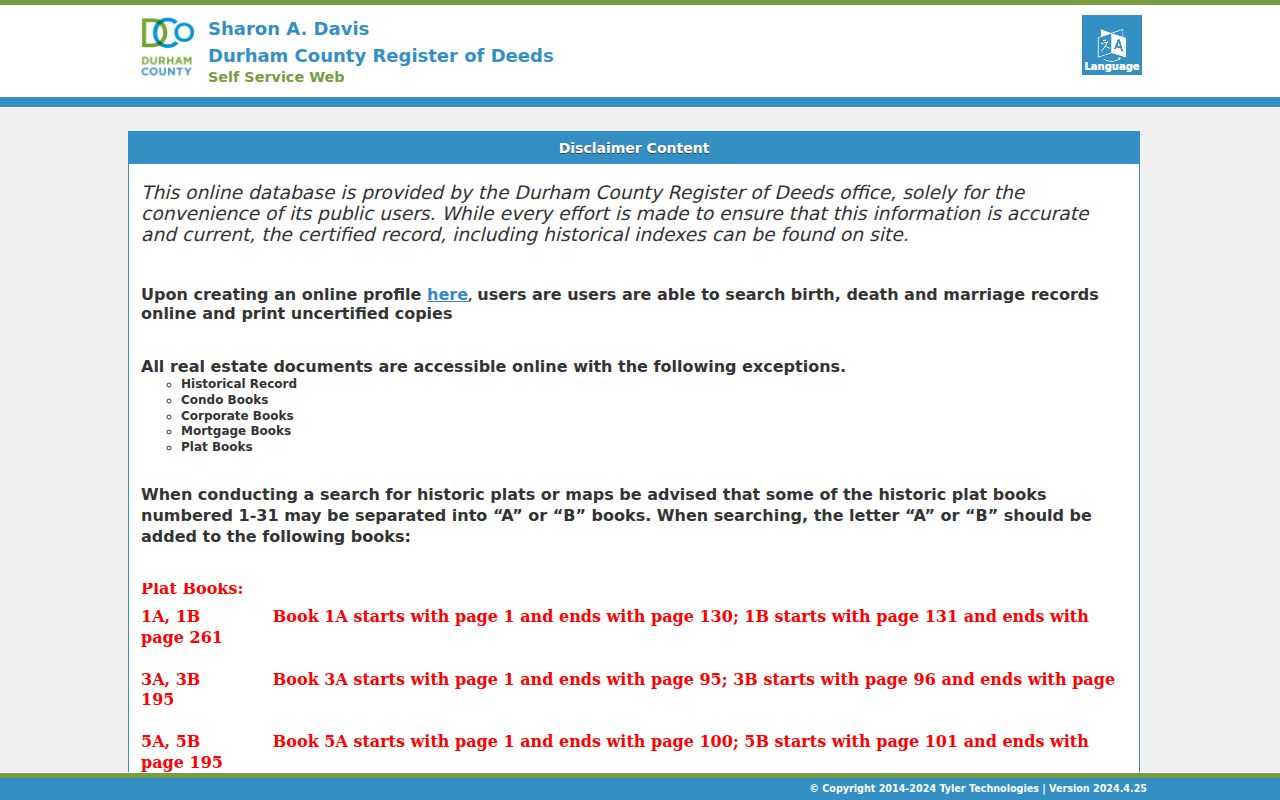
The opening screen is the gateway to party, instrument, and book-page searches, while the office remains the source for certified and older index work.
Note: Preserve the exact spelling shown in an index, even when a later source uses a corrected form.
Durham Property Search From Address
Property research crosses three systems. The tax record supplies the current January 1 owner, owner mailing address, situs address, REID, PIN, values, deed reference, recent sales, and map link. The situs is the parcel's physical location; the mailing address is where tax correspondence goes. Neither field alone proves where a person lives. A company, estate, or distant owner may appear instead.
- REID
- Durham County's real-estate record identifier.
- PIN
- The parcel identification number, usually 10 digits and 13 for a condominium.
- Plat
- A recorded map that fixes a subdivision, lot, or survey boundary.
- Deeded acreage
- The area stated in the legal description, which can differ from GIS-mapped acreage.
Durham's search form has a local quirk. Enter the street name without “Road,” “Drive,” or another suffix. If no match appears, omit a direction such as West. Condominium addresses need extra care because one building can contain many separately owned parcels.
The Durham real-property search accepts owner, address, REID, and PIN inputs.
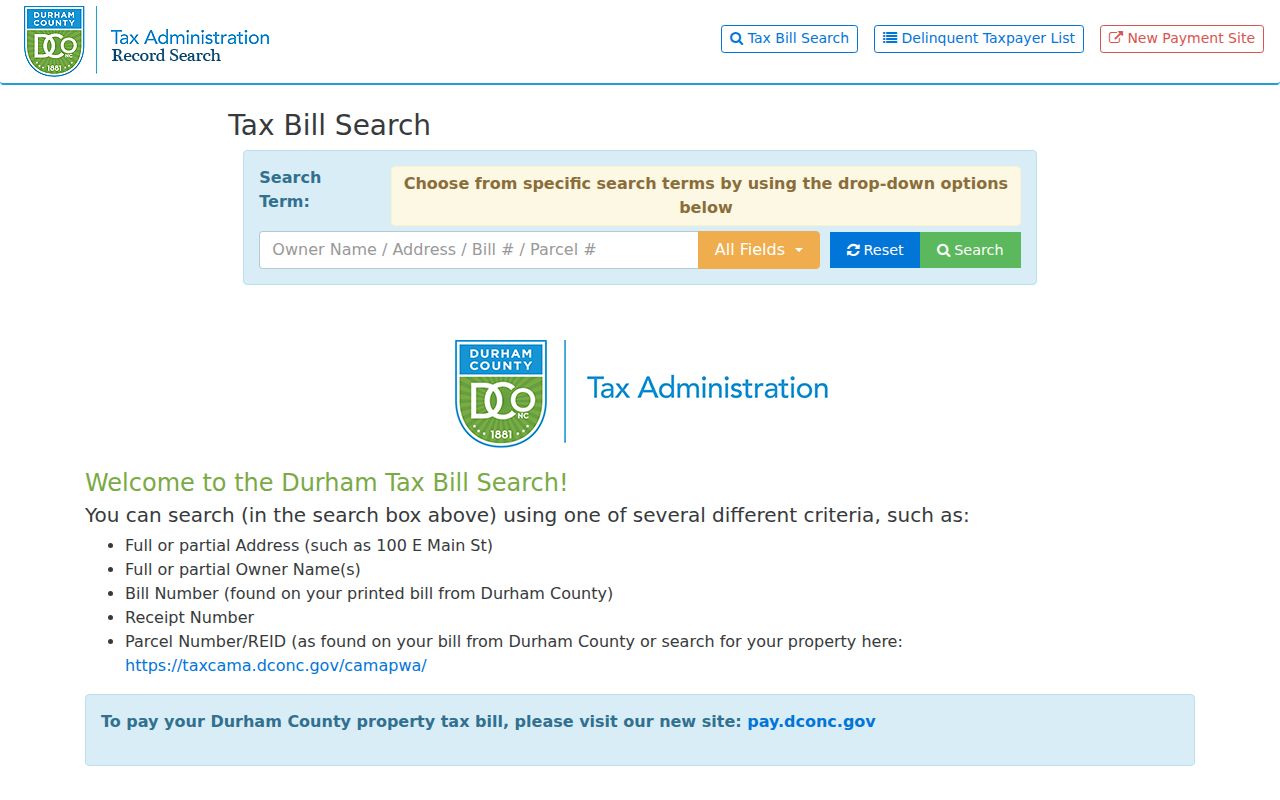
A matched parcel becomes the bridge to its deed book and page, tax mailing address, map, and ownership history.
Durham Search Across Two Governments
Durham's city and county share a name, but their records portals are not interchangeable. City departments keep council, planning, code, contract, claim, and cemetery material. County departments keep county administrative files. The Register, Sheriff, courts, and state agencies still use their own channels. A postal address that says Durham also may sit outside the city limits.
Use the FAST map to check the parcel, address point, jurisdiction, zoning, and annexation setting for the relevant date. A later annexation can place early permit or complaint records with the county and later ones with the City. ZIP codes describe mail delivery, not city limits.
The Durham interactive GIS provides the parcel and jurisdiction layers used for that check.
FAST can filter layer tables and export data, but each download should retain its date because ownership, addresses, and annexations update on separate schedules.
Search Durham Court Records by Name
North Carolina District and Superior Courts serve Durham County. The statewide eCourts Portal can return a case number, caption, court location, parties and roles, case type and status, docket events, hearings, dispositions, and eligible public documents. A docket is the dated list of actions in a case. Portal's Register of Actions is a summary, not the clerk's official record.
| Channel | Durham record scope | Best next step |
|---|---|---|
| eCourts Portal | Public statewide case summaries and judgments | Copy the case number |
| Courthouse terminal | Criminal, civil, estates, and special proceedings | Ask the proper clerk division for the file |
| PACER | Middle District federal cases | Use party, court, case, and date filters |
Adoption, juvenile, sealed, expunged, and certain protective-order or mental-health records do not appear as ordinary public results. Same-name cases require care. Compare address, age or date information, middle name, attorney, and related parties before drawing a link.
Note: A courthouse terminal may expose broader index detail than an anonymous web session, but sealed records remain unavailable.
Durham Vital Records Search Trails
For an event in Durham County, the Register of Deeds issues available birth, death, and marriage certificates. North Carolina Vital Records holds statewide birth certificates from 1913, deaths from 1930, marriages from 1962, divorces from 1958, and fetal-death reports from 2001. A divorce judgment and its full case file come from the Clerk of Superior Court, not the state certificate office.
Certified birth and death copies are limited by N.C.G.S. §130A-93 to the named person and specified relatives, representatives, agents, or people establishing a legal personal or property right. Marriage records and indexes held by the Register are public. Adoption files remain sealed. For earlier family research, turn to delayed registers, churches, cemeteries, newspapers, probate, census sources, and the State Archives.
The North Carolina Vital Records portal starts state certificate applications and case services.
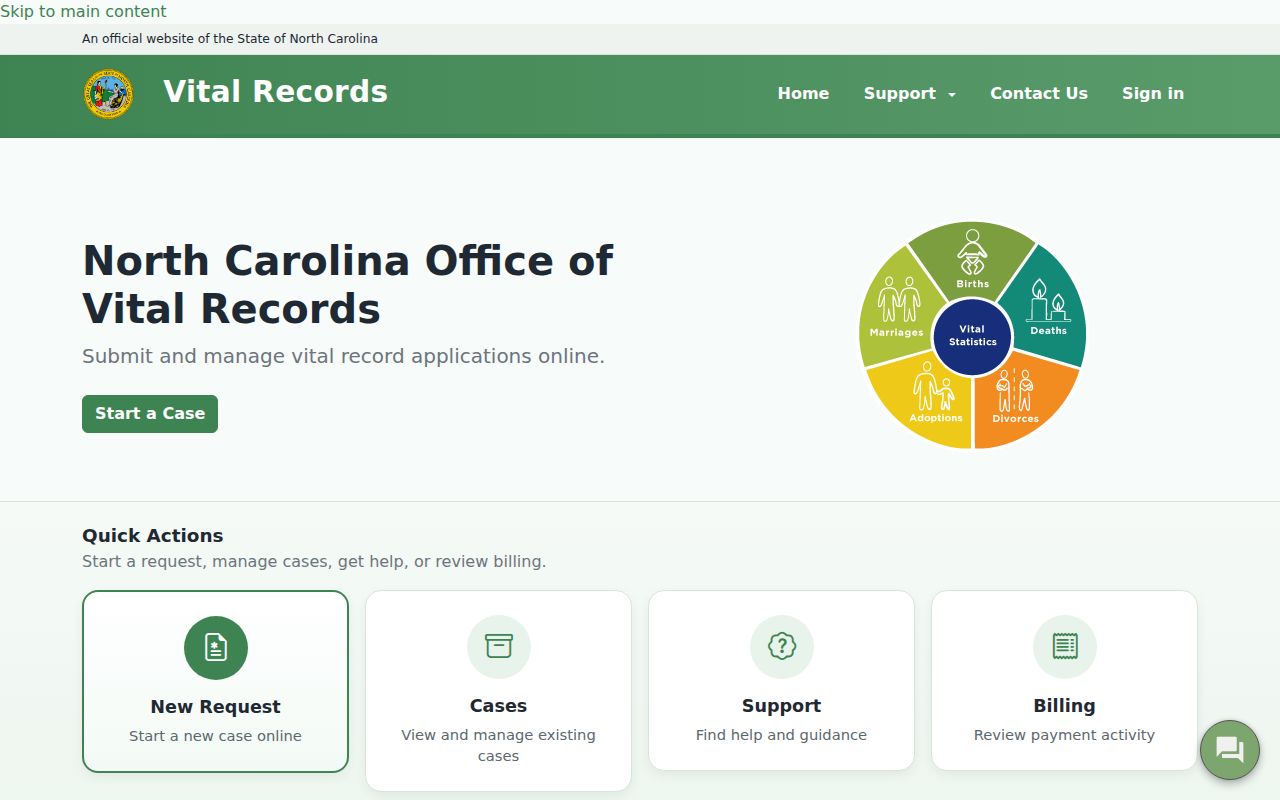
The application route requires event facts, requester identity, relationship or legal interest, and current payment and delivery choices.
Durham Library Search Before Digital Records
The North Carolina Collection at Durham County Main Library bridges modern portals and past residents. Annual city and county directory holdings reach back to 1903, with several volumes from 1892. Digitized directories from Durham contributors span 1875 through 1963. Telephone books cover 1927 and 1950 through 2016, while cross-reference books run from 1962 to the present.
An alphabetical entry can show a name, spouse, occupation, employer, and address. The street section reverses the order so an address leads to listed occupants and neighbors. These books do not prove continuous residence, but they can place a person at a published address and year. Durham's people directories also preserve the deeper catalog and education collections.
The library's exact directory holdings also point to the complete local newspaper microfilm runs, yearbooks, subject files, and nearly 400 archival collections.
The 1886 Tobacco Belt Directory carries a rare historical convention: an asterisk marks Black businesses and landowners. Treat that symbol as the publisher's period classification, then add context from the Carolina Times, Hayti, and Parrish Street collections.
Durham Records Behind Estate Searches
An heir or estate search often joins court and land files. Search eCourts under the decedent's name and the estate caption. Then obtain the public estate file or index from the Clerk of Superior Court. It can identify the appointed personal representative. A deed from an estate, lien, or later parcel record can connect that proceeding with real property.
Older cases may move the search beyond Durham County. Durham County formed in 1881 from Orange and Wake counties and gained more Wake land in 1911. Land, marriage, estate, tax, and court events before formation may sit with a predecessor county. Map the place as it existed on the event date before concluding that a record is missing.
A filing address for an heir or representative shows where court papers were directed at that time. It is not proof of the person's current home. Confirm it through later public records when a current contact matters.
Durham Search for Custody Records
Local jail, state correction, and federal custody records answer different questions. The Durham Sheriff inmate population search covers current local detention and lists confinement, charge, release status, bond, statute description, court docket, and days in jail by charge. A charge is not a conviction. Copying the docket number creates the safest bridge to the court case.
The Durham Sheriff detention channel handles local custody questions. The state offender search covers North Carolina prison, probation, and parole data back to 1972, not the county jail. Federal custody from 1982 onward belongs in the Bureau of Prisons locator.
Use custody data with care. Verify the person through the docket, dates, photograph, and other public identifiers. Never contact, threaten, or harass someone based on a roster or registry match.
Police reports form another trail. North Carolina law generally protects criminal investigative and intelligence records while opening specified incident and arrest facts. Ask Durham Police or the Sheriff's records unit for its own material.
Durham Business and License Records
A business name can reveal a person through an entity filing, assumed-name certificate, UCC index, permit, inspection, or professional credential. North Carolina's Secretary of State search can show an entity's status, registered agent, offices, officials, and filing history. A registered agent is the service contact. That role does not automatically identify the owner.
The state business registration search works best with a legal entity name or SOS ID. The North Carolina license hub routes searches to the board for doctors, nurses, lawyers, contractors, brokers, and other regulated work. Board results may show credential status and public discipline.
A separate NC Cash name search can connect a current or former name with property reported to the State Treasurer. A match begins an official claim process and should be checked without paying an outside advance fee.
Durham has no verified universal local business-license roll. Depending on the activity, the useful local record may be a zoning application, food inspection, ABC permit, assumed name, or profession-specific license. Match the entity address and official name before connecting it with a person.
Durham Voter Search Boundaries
North Carolina's public Voter Search can locate an individual registration by first and last name, with middle initial, birth year, county, and status filters to narrow the result. A matched Durham profile may show status, party, registration date, districts, precinct, polling place, election aids, and participation history. It never reveals ballot choices.
The state's downloadable files support broader analysis, while Durham's Board of Elections publishes local exports and long-run election material. Full dates of birth, Social Security and driver-license numbers, election email addresses, copied signatures, and qualifying protected addresses remain confidential. The complete field and file rules are explained with the Durham voter records.
Note: Search both registered and removed-or-denied modes before deciding that an older Durham registration record is absent.
Protecting a Durham People Search
North Carolina's Address Confidentiality Program gives qualifying relocated victims a substitute address for new public records. A participant must ask an agency to use it. Actual address and telephone information held under the program are generally excluded from public access. A related voter procedure can protect the residence address while leaving the name, precinct, and other registration fields open.
Protected identifiers in a deed or court image have a separate remedy under N.C.G.S. §132-1.10. The person named can send a signed request that identifies the information, document, page, and position. The office removes the identifier from the public web image or copy without a fee, but the underlying recorded instrument remains.
Lawful access is not permission to track or frighten someone. North Carolina stalking and cyberstalking laws apply even when the first fact came from an open record. Use official sources for family history, estate work, civic oversight, and scam checks. Stop when a record is confidential or a person's safety is at risk.
Verify Durham People Search Matches
A Durham name may surface in several accurate records that describe different roles. The deed can name the titled owner, the parcel card can name the tax correspondent, a directory can list the occupant, and an estate file can identify a representative. Four names at one address do not create a contradiction. They may document ownership, notice, residence, and authority at different times.
| Result | What it establishes | What it does not prove |
|---|---|---|
| Parcel card | Listed owner and tax facts | Current occupancy |
| Recorded deed | Legal title transaction | Present contact details |
| City directory | Published name and address for a year | Continuous residence |
| Court docket | Indexed case role and events | Every fact alleged in a filing |
Save the source URL, retrieval date, record number, and spelling shown. Then compare at least two independent identifiers. That habit guards against common-name errors and leaves a clear route back to the custodian when a copy, correction, or certification is needed.
The Durham County request portal lets users search earlier releases and submit a detailed request for county administrative material.
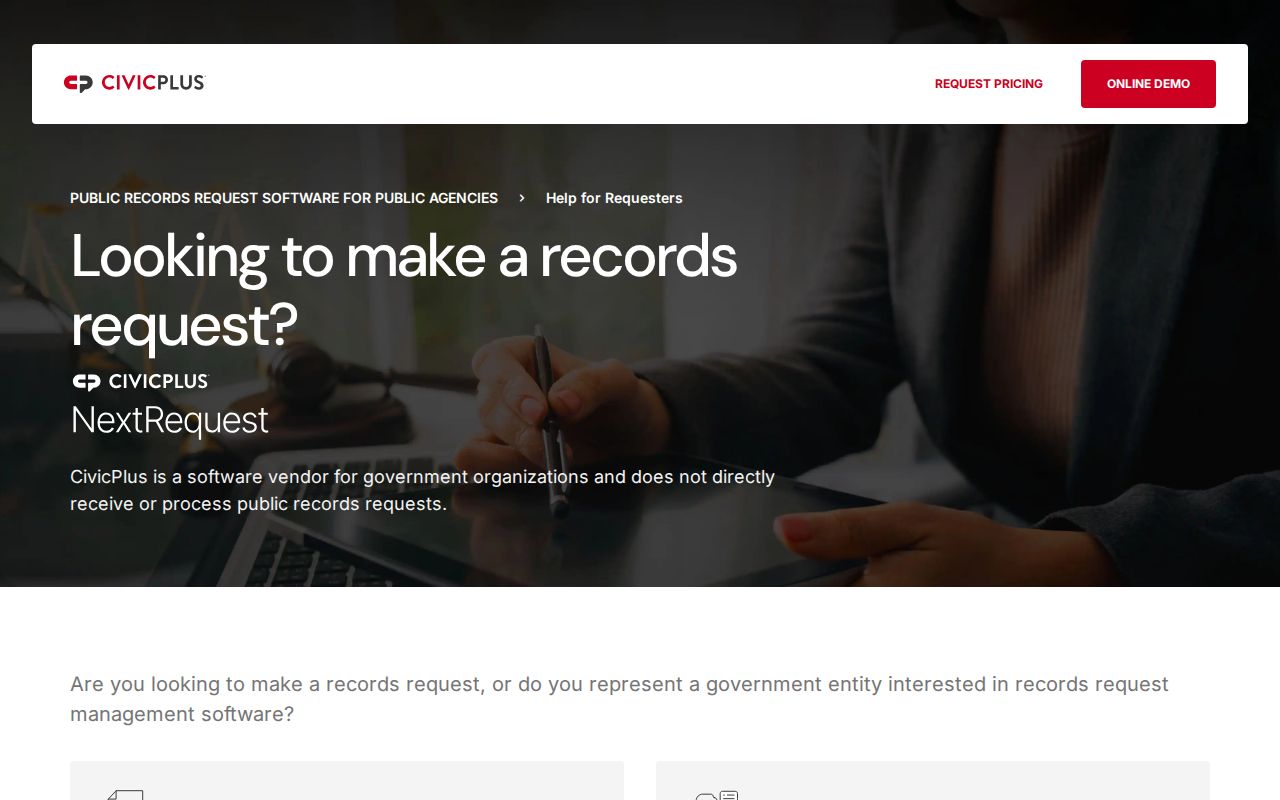
The portal supplies confirmation and status notices, but specialized records still go to their legal custodian.