
Trace Durham Voter Registration Online
The NCSBE Voter Search information page is the first stop for one person. It covers all 100 North Carolina counties. Enter the first and last name, then choose Durham County when a common name produces several matches. A middle initial and birth year can narrow the set. Search both the registered and removed-or-denied categories when the current roll has no result. The portal is an individual lookup, not the best tool for studying a whole voter roll.
| Search control | Input | Needed? | How Durham searchers use it |
|---|---|---|---|
| First Name | Text | Yes | Given name; matching is not case-sensitive |
| Middle Initial | Text | No | One letter can separate like names |
| Last Name | Text | Yes | Enter the surname |
| Year of Birth | Four-digit year | No | Used to narrow results; full birth date is not shown |
| County | Dropdown | No | Select Durham to filter out other counties |
| Registered | Checkbox | No | Search current registration records |
| Removed or Denied | Checkbox | No | Check records outside registered status |
Open the most plausible match and compare the county, status, party, registration date, precinct, and districts. Do not rely on the name alone. The county elections office can help when a status change or older entry needs context. For bulk research, use the official downloadable files instead of trying names one by one.
The state voter lookup form shows the name and county controls used for a Durham voter registration search.
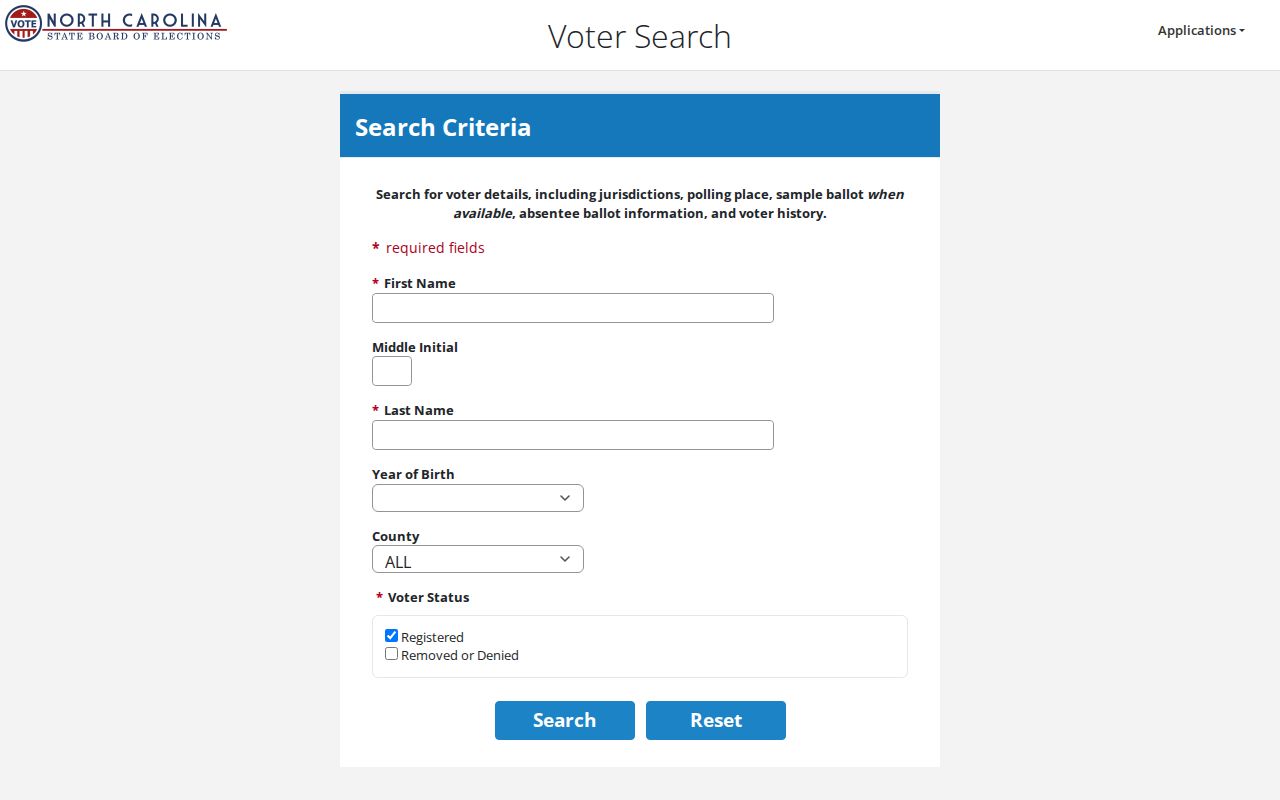
The form also separates registered profiles from removed or denied entries, which makes a second search worthwhile after a blank active-roll result.
Inside a Durham Voter Profile
A matched NCSBE profile is a live administrative record, not a scan of the signed application. Its parts answer different questions. The state's voter-record field guide explains the details, polling-place, jurisdiction, sample-ballot, absentee, and history blocks.
| Identity and status | Name, county registration number or NCID-linked record, status, party, and registration date |
|---|---|
| Local assignment | County, precinct, residential address when not protected, and polling place |
| Districts | Congressional, legislative, judicial, county, school-board, and applicable city or ward districts |
| Election aids | Election Day location, available sample ballot, and applicable absentee information |
| Participation history | Election, date, and voting method, but never selections made on a ballot |
These fields can confirm that two like-named profiles belong to different people. They can also show which set of local contests applied to a Durham address. District assignment is an election-administration fact, not proof that the public address is a person's current location outside the registration system.
North Carolina Voter Records Boundaries
North Carolina General Statutes § 163-82.10 makes the statewide system the official list and draws the public line. Name, precinct, status, party, registration date, nonprotected address, and election districts are public. The law does not make every item on the application open. It protects a full or partial Social Security number, birth date, driver-license number, election-law email address, registration agency, and voter-ID image.
Confidential by North Carolina law. Protected identifiers stay out of voter records, and a qualifying residential address is withheld under § 163-82.10(e). A signature may be viewed but not copied or traced by the public.
A voter with a qualifying protective order or current Address Confidentiality Program card may file the required safety statement. Election officials retain the actual address to administer elections but withhold it from general inspection. The Chapter 15C Address Confidentiality Program also protects the participant address. The name, precinct, and other registration facts remain public while the address protection is active.
Durham Voter History Has Limits
Voter history records participation, not choice. A row may show the election date and name, precinct, county, party, and voting method. It never reveals a candidate, referendum response, or ballot selection. That distinction matters when reading a public profile or the NCSBE voter-history files.
The current history file has one row for each election participation within the past ten years. It omits names and demographic fields, but analysts can join it to the voter registration file by NCID or by county plus registration number. A county file concerns voters now registered in that county. For a sound count of who voted in Durham in a past election, NCSBE says to use the statewide file and filter the voted-county field.
Common myth: A history row proves only that the voter took part and records a method. The secret ballot prevents it from becoming a record of votes cast.
Download Durham Voter Registration Files
NCSBE voter-registration data provides a direct Durham County ZIP file and a statewide file. Ordinary public registration data is not limited to a party or campaign. Downloads are free and update weekly on Sunday evenings. They include currently and formerly registered people, along with denied or incomplete registrations, plus public status, party, address, precinct, demographic, and district variables.
- Choose the dataset. Use the Durham ZIP for current county-focused work, or the statewide file when movement between counties matters.
- Read the layout. Keep the official field guide close so status codes, district columns, and identifiers are interpreted as NCSBE defines them.
- Filter without altering the source. Work from a copy and retain the download date because a weekly roll can change.
- Use the right join. Connect history with registration data through NCID or county plus registration number.
- Request only what is missing. Send a custom request to the Durham Board when posted files do not answer the record question.
The official public voter-file download page lists current county files, historical data, and documentation.
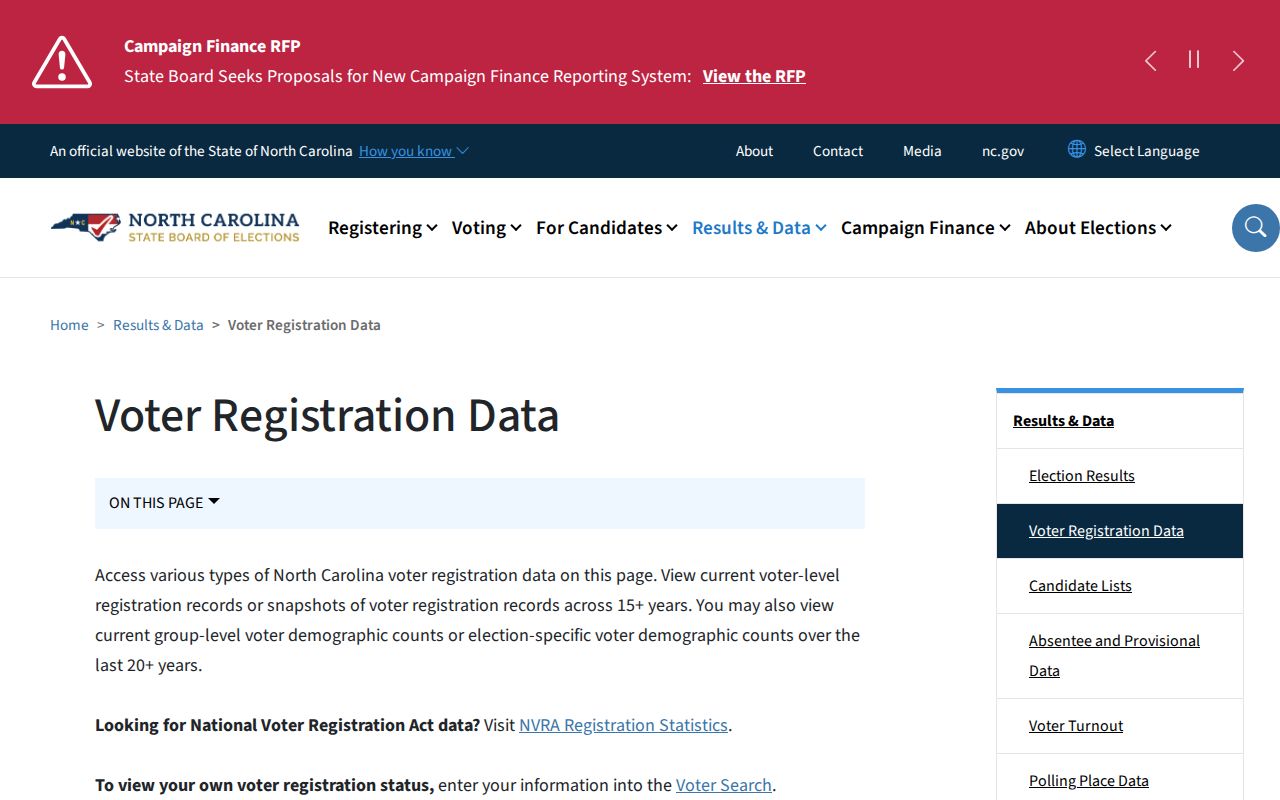
That download route is the right scale for whole-roll analysis, while the name portal remains better for checking one profile.
Years of Durham Voter Rolls
Current files are only one layer. NCSBE publishes more than 15 years of registration snapshots and more than ten years of voter-history data. Group-level history statistics reach beyond 20 years and can be sorted by county, precinct, voting method, party, race, ethnicity, sex, and age. These time spans help separate a present registration question from a trend question.
Durham County offers more local depth through its election records exports. Posted files include registered voters by municipality, new registrations, party changes, several district summaries, and demographic workbooks. One active, inactive, and temporary-registrant history workbook runs from 1985 to the present. Candidate filing records go back to 2004, and official election results reach 1968. Those are dated election records, not substitutes for a current profile.
Note: Keep the file date and source with every extract because current registration and history downloads follow different update and coverage rules.
Durham Voter Status Changes
An empty active search does not prove that someone never registered. The lookup has separate controls for registered and removed-or-denied records. Downloaded data adds status and reason fields for active, inactive, removed, denied, and incomplete records. Search both portal categories before drawing a conclusion.
Returned mail and address-confirmation steps may move a record to inactive status. Removal does not occur merely because a person missed one election. Federal National Voter Registration Act safeguards and North Carolina election law govern list maintenance. When the timing of a change matters, preserve the search date, compare the current Durham file, and ask county staff about the retained administrative record.
Daily Durham Registration Snapshot
The Durham Board of Elections publishes a public-facing demographic snapshot that updates daily at noon. On July 28, 2026, it reported 247,806 registered voters: 121,562 female, 95,943 male, and 30,301 undesignated. The same dashboard breaks out party, race, and age. Any quoted number needs its date because the figures change.
A live total answers a different question than a weekly file or a historical workbook. Use the Durham elections dashboard for a timely county count, the weekly NCSBE download for row-level current data, and dated county exports for past comparisons. This split prevents a daily headline figure from being mixed with a file made on another schedule.
Durham Voter Records Access Desk
The Durham County Board of Elections is the local fallback for a custom file, an unclear status, or a record not already posted. Requests may be made through the electronic Public Records Request Form, by email, by phone, by mail, or at the counter. The county fills requests in order, asks users to allow up to three business days, and requires prepayment for printed records. It does not state a separate fee for custom electronic extraction, so ask before assuming a charge.
Durham County Board of Elections
3825 S. Roxboro Street, Suite 101
Durham, NC 27713
Monday through Friday, 8:30 a.m. to 5:00 p.m.
919-560-0700
elections@dconc.gov
Mail and Online Requests
P.O. Box 868
Durham, NC 27702
Fax: 919-560-0688
Public files and request form
Board contact details
NCSBE remains the state fallback for registration and participation downloads. General North Carolina access-law context belongs with Durham public records procedures, while the elections board handles the voter roll itself.
Historical Durham Voter Records
Older poll lists and registration rosters may not appear in the current online tools. Ask the county board what it retains, then use the State Archives local records schedule to identify the series. The schedule recognizes poll lists, registration lists, rosters, and authorizations to vote as county election-board records.
No exact online catalog run was found for surviving Durham volumes. Request a catalog search instead of assuming that each year exists. County geography also matters for older research: Durham County was formed in 1881 from Orange and Wake counties and gained more Wake land in 1911. For events before those changes, check the election-era jurisdiction rather than applying today's county line.
Note: Historical election evidence may be a paper register, poll list, archive series, or dated result, not a modern voter profile.
Use Durham Voter Records Lawfully
Public access does not permit stalking, threats, or harassment. G.S. 14-277.3A covers a willful course of repeated conduct without legal purpose when the actor knows or should know it would cause fear for personal or family safety or substantial emotional distress. A first offense is a Class A1 misdemeanor; repeat or protective-order cases can become felonies.
Use limit. Do not use a public address or voter status to monitor, threaten, track, or contact someone unlawfully. Chapter 15C also penalizes knowing unauthorized acquisition or disclosure of a protected program address.
North Carolina's cyberstalking law, G.S. 14-196.3, separately addresses prohibited electronic tracking and communications. These limits still apply when the first name or address came from a lawful public search. Verify a same-name match, respect protected data, and use official records for civic or personal research without turning access into harm.