
Durham People Directories at a Glance
No one directory lists everyone connected to Durham. Durham city, county, state, school, and university sources publish only the contacts tied to their work. Public record indexes create other name lists, while Durham library volumes recover people and businesses from years before online search. These people directories differ in both purpose and access, so the best starting point depends on the link being tested.
| Directory | Who It Lists | Keeper | Access |
|---|---|---|---|
| City Staff Directory | Departments, officials, and selected staff | City of Durham | Free web search |
| County department lists | Published county staff by department | Durham County | Browse department pages |
| NC Employee Directory | State workers and agency contacts | State of North Carolina | Free web search |
| Campus directories | Faculty, staff, students, and affiliates as allowed | Duke, NCCU, Durham Tech | Public or partly restricted |
| Real Property Record Search | Parcel owners and tax mailing contacts | Durham County Tax Administration | Free web search |
| Historical directories | Past residents, firms, and street occupants | Durham County Library | Print, microfilm, and digital |
Use a Durham agency directory for a public contact and an institutional directory for a campus affiliation. An address question belongs in the Durham tax roll or a reverse volume. A business name may lead to a state filing or credential board. Historical Durham residents require a publication year, since a printed entry proves only what that edition reported.
Search Durham City Staff
The City of Durham Staff Directory combines a department browser with a person search. Its long category list reaches City Council, the mayor, the clerk, Fire, Parks and Recreation, Planning and Development, Water Management, and many smaller divisions. A blank category can search more broadly. The form needs JavaScript to display entries, so a department page or main telephone line is the practical fallback when results do not load.
| Search Field | Type | Required | How It Works |
|---|---|---|---|
| Category | Dropdown | No | Select a department or division, or leave blank |
| First Name | Text | No | Staff given name |
| Last Name | Text | No | Staff surname |
| Search | Button | Not applicable | Runs the selected query |
The live City directory form shows those three filters before its staff results.
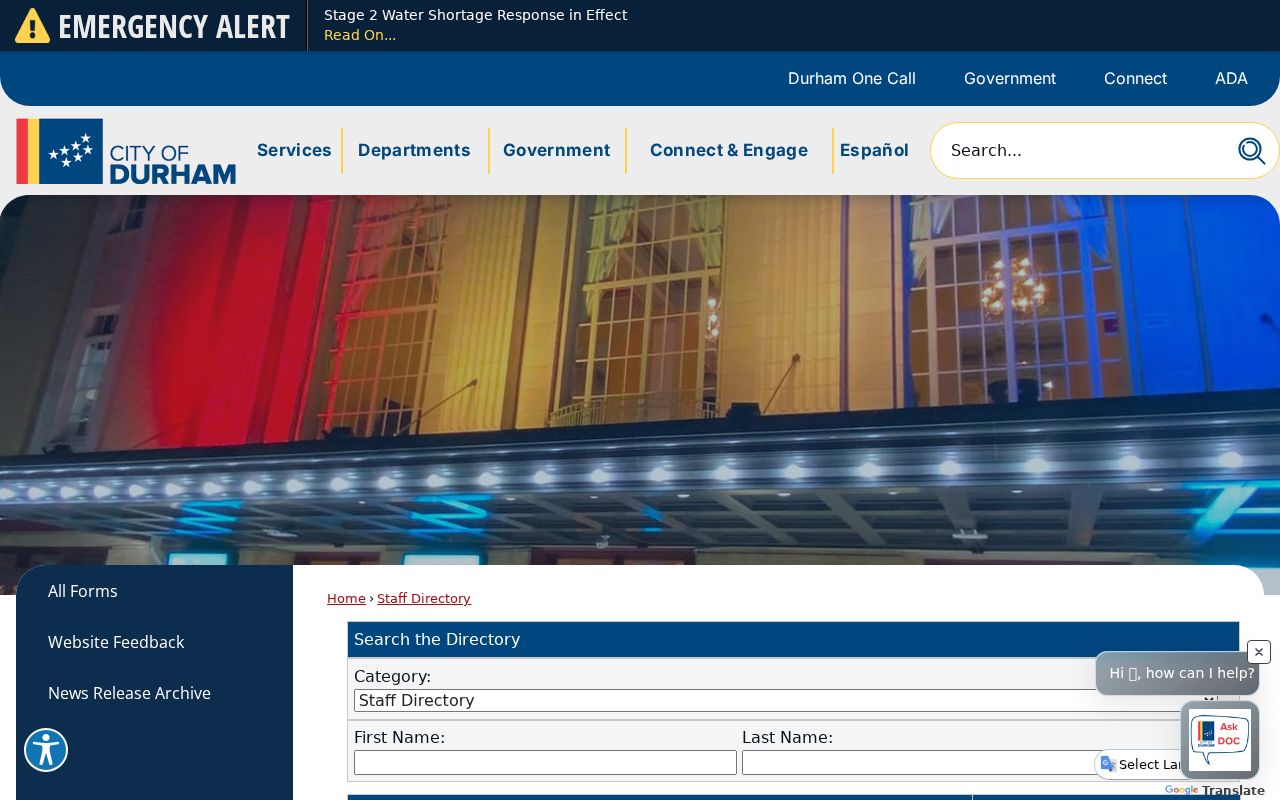
That Durham layout favors a known surname or organizational unit. It does not act as a downloadable countywide roster. When a name is absent, use the department page or main line, then ask the correct City or County custodian for the specific administrative record.
Durham Government Directory Entries
Durham County has no verified all-employee search that mirrors the City form. The county department directory fills the gap with agency links, office contacts, and department leaders. Finance publishes names, titles, email addresses, and telephone numbers, while Human Resources has staff profiles with positions and contact details. Elected-official rosters, board membership pages, agendas, and minutes also work as dated civic directories because they place a named person in a public role at a stated time.
A Durham City General Services contact entry illustrates the fields, but it should not be read as a promise that the same person still holds the post.
- Full name: the published contact name
- Role: the title and functional group
- Email: a work email link when supplied
- Telephone: a direct or main number, sometimes with an extension
- Grouping: a unit such as Facilities, Real Estate, or Urban Forestry
For state agencies, the North Carolina Employee Directory accepts first or middle name, last name, and agency. Results may include phone, email, and a Mail Service Center address.
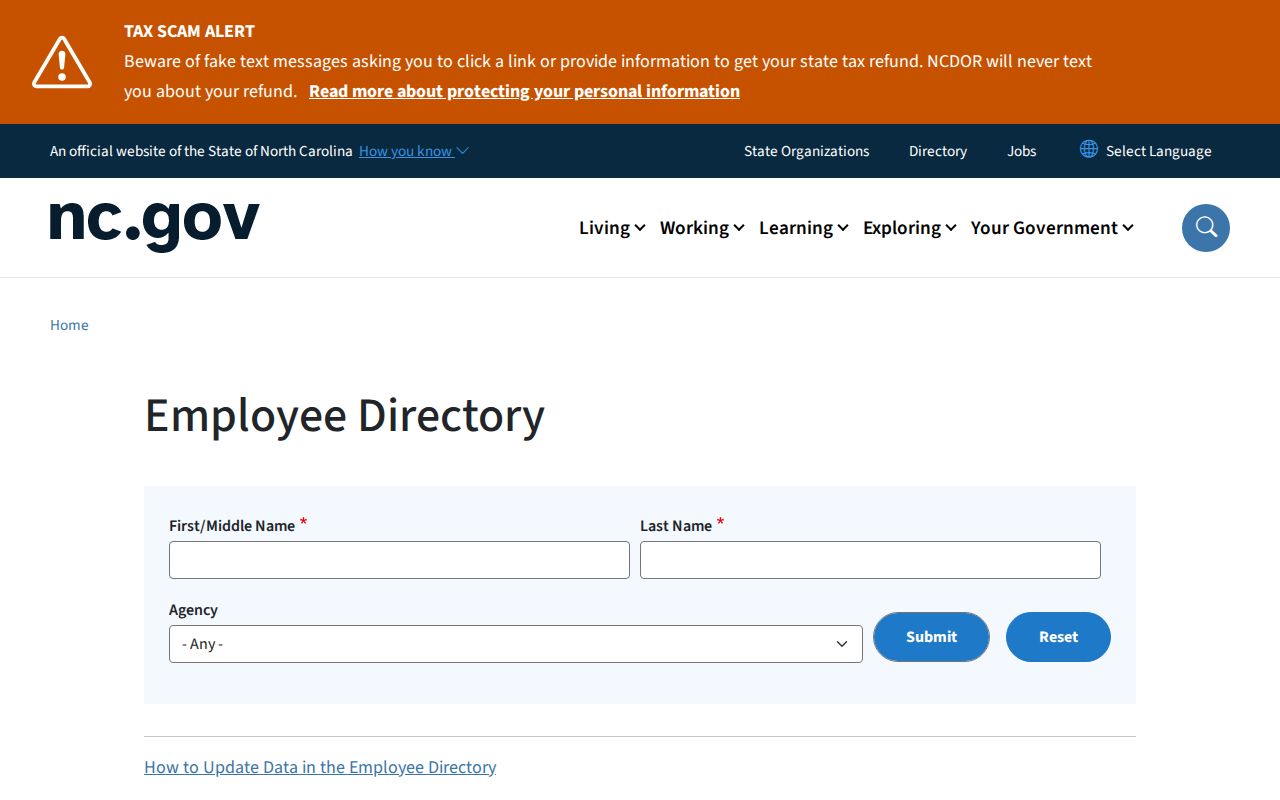
The state form covers North Carolina agencies, not City of Durham or Durham County personnel.
Durham Campus Directory Routes
Education directories divide Durham into distinct communities. Durham Public Schools lets users filter staff by name, with Durham school pages available when the district result is unclear. North Carolina Central University publishes a faculty and staff directory. Durham Tech lists faculty, adjuncts, staff, and administrators in a detailed table. The Durham college directory displayed 1,068 matches on July 28, 2026, with 50 results per page and columns for full name, title, email, phone, and office.
Duke University’s person-directory search serves students, faculty, staff, and affiliates within the institution’s publication and access rules.
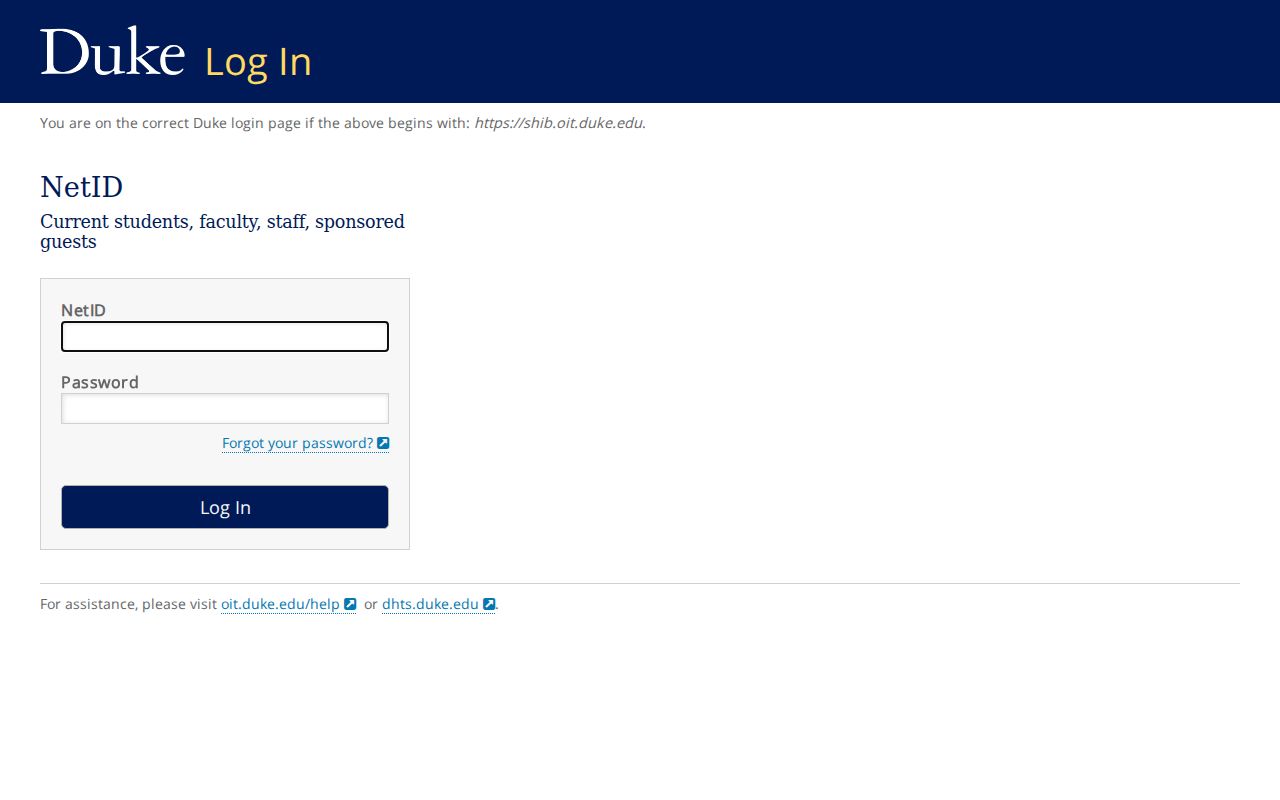
Some broad Duke functions require institutional access, while selected department listings remain public. For past affiliations, Duke University Archives, NCCU University Archives, yearbooks, catalogs, and student publications are better sources than a current contact directory.
Directory limit: No match may reflect publication or privacy rules. It does not prove that a person lacks an institutional connection.
Durham Property Owner Directories
The Durham County tax roll functions as an owner directory. Its Real Property Record Search accepts an owner, street number, street name, REID, or PIN. A matching parcel can show the January 1 owner, tax mailing address, physical location, legal description, values, and deed book and page. REID is the county’s real-estate record identifier. PIN is the parcel identification number.
Durham ownership is not the same as occupancy. A mailing address may differ from the property’s physical address, and neither proves where a person now lives. Durham GIS adds parcel boundaries, address points, zoning, and annexation context. The Durham Register of Deeds grantor-grantee index then connects names to recorded instruments and prior title transfers. Voter profiles and business filings can also operate as narrow public directories, but each has separate limits. General access rules and copy routes belong with Durham public records.
Note: A tax display can change after a life event, but only a recorded instrument changes legal title to the land.
Durham License and Business Directories
North Carolina has no single professional list. The state professional-license hub points to the board responsible for each field. Separate official searches cover doctors and physician assistants, nurses, lawyers, general contractors, real-estate brokers and firms, cosmetic-art practitioners, and ABC permittees. Entries commonly show a credential number, status, classification, public contact information, and public discipline when the board publishes it.
Durham business identity follows a different route. The Secretary of State entity search can expose a legal entity name, status, registered agent, company officials, addresses, and filing history. The assumed-name system adds person-name fields, date limits, and a Durham County filter. A registered agent is a formal service contact and need not be the business’s actual owner. Durham permits, inspections, and development files add local context, but no universal local business-license directory was verified.
Durham Library Directory Years
The North Carolina Collection on the third floor of Durham Main Library is Durham’s core historical directory desk. Its Durham holdings cover resident, business, street, and telephone searches across formats. Staff can also guide readers to Durham school yearbooks, newspaper microfilm, subject files, and nearly 400 archival collections. Contact before a visit when the year or publication is uncertain.
| Collection | Years Held | Arrangement or Access |
|---|---|---|
| Durham city and county directories | Annual print editions from 1903, plus volumes dating to 1892 | Alphabetical and street sections at NCC |
| Digitized directories | 1875–1963 | DigitalNC |
| Durham telephone books | 1927 and 1950–2016 | Library holdings |
| Greater Durham cross-reference directories | 1962–present | Telephone number and street address order |
The library’s directory inventory publishes the exact runs and formats.
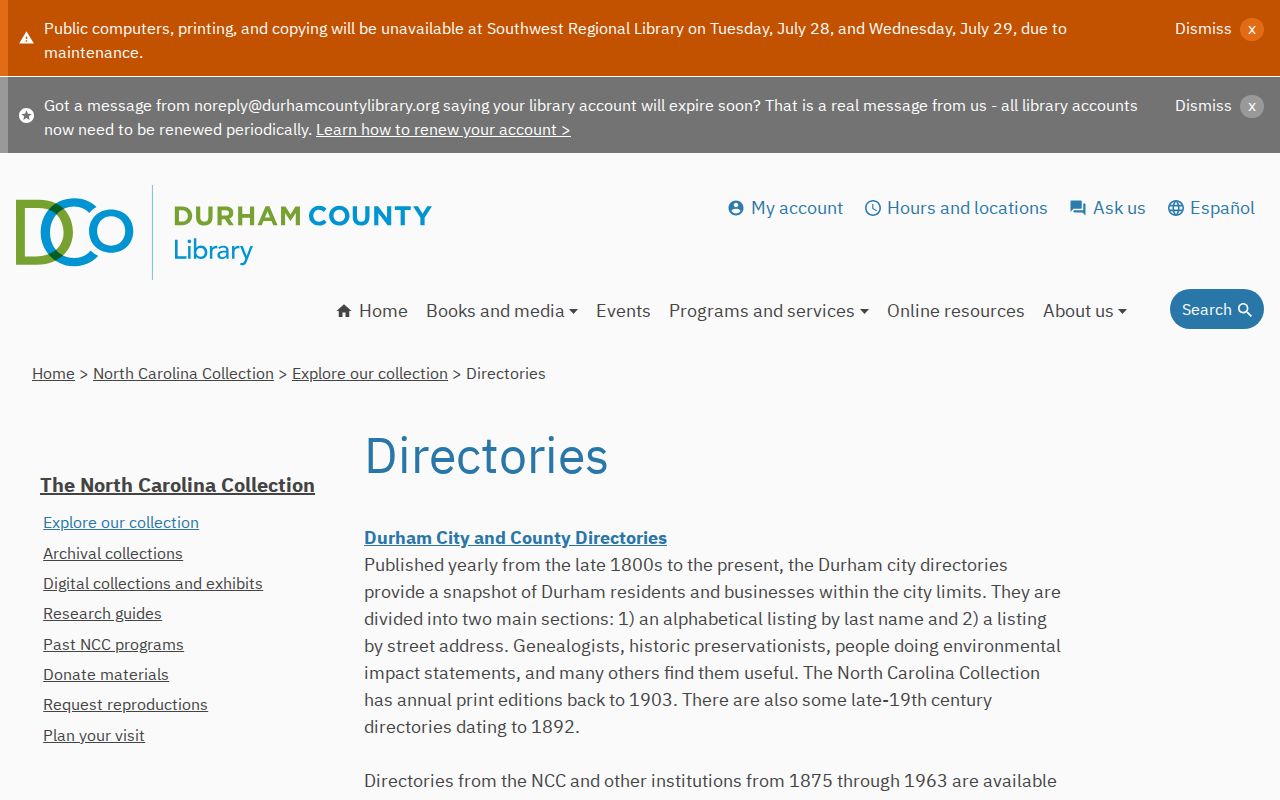
The inventory makes gaps visible before a trip and points to digital copies where available. Main Library is at 300 N. Roxboro Street, and the collection can be reached at 919-560-0171 or ncc@dconc.gov.
Reverse Durham Directory Searches
A standard city volume usually starts with names. Its street section reverses the view by placing an address before the listed occupant. Greater Durham Area Cross Reference Directories go further by arranging entries through street addresses and telephone numbers. These sources are especially useful for tracing who was listed at an old family home or identifying nearby householders who can distinguish people with the same surname.
- City directory
- A dated publication of residents and firms, often with address, occupation, employer, or spouse.
- Reverse directory
- An address-first or telephone-first list that points back to the published occupant.
- Telephone book
- A listing tied to telephone service, not a complete roll of all residents.
Start with the alphabetical entry, copy abbreviations exactly, and then check the same year’s street section. Phone books through 2016 can bridge later decades. A directory entry records what one edition printed, not unbroken residence, title ownership, or a current telephone number.
No authoritative current countywide residential white-pages database was verified for Durham. Public institution contacts and historical library holdings are the sound official alternatives.
Durham’s 1886 Directory Story
Charles Emerson’s 1886 NC Tobacco Belt Directory captures Durham County businesses, professional people, and landowners during the post-Reconstruction tobacco economy. The publisher marked Black businesses and landowners with an asterisk. That mark is a period indexing convention, not a modern identity label, and it needs context from other sources.
Pair a Durham entry with the Carolina Times, city directories, maps, and archival materials about Hayti and Parrish Street. The older 1877/78 state directory can fill another early gap, while Mangum’s Directory of Durham and Suburbs reaches some people and firms beyond the old city boundary. Together, these sources show why historic directories can reveal a community that a current institutional search cannot reconstruct.
Historical Durham Directory Timeline
Durham County formed from parts of Orange and Wake counties in 1881, then gained more Wake land in 1911. That geography changes where an early name may appear. Search Orange or Wake records for an event that predates Durham County, based on the location and year rather than the modern postal address.
- 1875–1963: Digitized directory material now available through DigitalNC spans this broad period.
- 1886: The Tobacco Belt volume lists local firms, professional people, and landowners.
- 1903 onward: The North Carolina Collection holds annual print city directories, plus several earlier volumes.
- 1927 and 1950–2016: Durham telephone-book holdings add name and number evidence.
- 1962 onward: Cross-reference volumes allow address-first and telephone-first searching.
Not every historical Durham source is online. The library holds full local newspaper runs on microfilm, school yearbooks, subject files, maps, and private papers. The State Archives supplies another route for transferred Durham County court, estate, marriage, and land series. Cemetery staff maintain Maplewood and Beechwood interment entries and can provide general information when no stable public name index exists. These fallbacks extend Durham directory research beyond current web forms without treating a private community roster as public.