
Durham Public Records Coverage
Access to Durham public records depends on the record, not just the name attached to it. Durham County keeps recorded instruments, tax parcels, and local vital certificates. The North Carolina Judicial Branch keeps Durham court files. City departments, the Sheriff, election officials, and state agencies each hold their own series. This coverage map leads with the normal access route and the fallback when the web does not supply the needed file.
| Durham record | Legal keeper | Web coverage | Copy or fallback |
|---|---|---|---|
| Deeds, liens, plats | Durham Register of Deeds | Free instrument index; official start year not stated | Historical indexes and certified copies at the office |
| Tax parcels | Durham Tax Administration | Owner, address, REID, PIN, values, deed links | Free search; Land Records counter |
| Civil, criminal, estate cases | Durham Clerk of Superior Court | Statewide eCourts case summary | Courthouse terminal, clerk file, paid copy |
| Birth, death, marriage | Durham Register of Deeds and NC Vital Records | Application routes, not unrestricted certificate browsing | Eligibility, identity, and copy fees apply |
| City and county administration | Creating department | Separate prior-request portals | Inspection or native electronic copy by request |
| Jail, corrections, registry | Sheriff, NC DAC, or NC SBI | Three separate official searches | Agency-specific request route |
An online row is an index or access copy unless the custodian says otherwise. Sealed cases, adoption files, juvenile material, protected identifiers, certain investigative files, and protected addresses do not become open merely because another part of the record is released. Motor vehicle personal information also follows federal restrictions. A voter-file question belongs in the full Durham voter records treatment, which covers its distinct public and confidential fields.
Chapter 132 Opens Durham Records
North Carolina General Statutes Chapter 132 defines a covered record by its link to public business, regardless of whether it is paper, email, audio, or data. Any person may inspect covered material at reasonable times and obtain a copy. The requester need not live in North Carolina or explain a purpose. The custodian must respond “as promptly as possible,” but the law sets no single deadline measured in days.
Ordinary uncertified copies of Durham public records may cost no more than actual direct reproduction cost unless another statute sets the charge. Extensive technology or staff work can support a reasonable special service charge based on actual cost. The agency should give an estimate, allowing the requester to narrow the scope. Inspection alone normally has no copy fee. If part of a file is confidential, the custodian should redact or separate that part and release the rest when feasible.
- Custodian
- The office that creates or keeps the requested record and controls access to it.
- Index
- A finding aid that points to a file or instrument; it is not always the complete image.
- Certified copy
- A copy authenticated by the issuing office for an official use.
- Exemption
- A law that requires or permits information to be withheld from general access.
G.S. 132-9 allows a denied requester to seek an order in superior court after following the statute’s mediation provisions. A sound first response to a denial is more modest: ask for the exact exemption, request all segregable portions, and narrow an overly broad date range or record series.
Fields Inside Durham Deed Records
The Durham Register of Deeds search landing page opens the recorded-instrument index after a disclaimer. The county calls the online display a convenience copy. It does not publish a dependable first year for all indexed document types. Certified instruments and historical indexes remain available through the office, so an empty web result does not settle an older title question.
| Search control | Input kind | Needed? | How Durham uses it |
|---|---|---|---|
| Party or last name | Text | Depends on mode | Find a grantor or grantee; try spelling and punctuation variants |
| First name | Text | No | Narrow a common surname |
| Party type | Choice | No | Separate the conveying and receiving sides when available |
| Document type | Menu | No | Limit deeds, plats, liens, satisfactions, or other instruments |
| Begin and end date | Date pair | No | Restrict the recording period |
| Book and page | Paired text | Mode based | Retrieve a citation copied from a tax card or prior deed |
| Instrument number | Text | Mode based | Open a known document entry directly |
Grantor means the party who conveys an interest. Grantee means the receiving party. The result may show the party names, type, recording date, instrument number, and book/page. The recorded instrument, not the tax ownership history derived from it, controls the legal title record.
The Register publishes its current recording, copy, certification, and vital-record charges in the Durham fee schedule.
Note: Call the Register at 919-560-0480 before relying on web coverage for an older year or requesting an authenticated copy.
Durham Property Records Connect Systems
Durham’s property trail crosses Tax Administration, GIS, and the Register of Deeds. The Real Property Record Search accepts an owner, street address, REID, or PIN and returns the current assessment record. A situs address is the parcel’s physical location. The owner mailing address is where tax notices go, and it may differ. Neither field alone proves where a person lives.
The parcel record adds deed book/page, legal description, values, recent sales, photographs, and links to its map and tax bill. Use the deed citation to open the recorded instrument. Durham’s FAST interactive map adds parcel bounds, address points, zoning, districts, and annexation context when the text search fails. GIS acreage is a mapped calculation; deeded acreage comes from the legal description. A difference can reflect mapping method rather than a title conflict.
- Search owner, street number and street name, or parcel ID. Omit the street suffix and try without a direction if the address fails.
- Copy the REID or PIN, standardized situs, owner mailing address, and newest deed book/page.
- Use the book/page in the Register index. Read the grantor, grantee, date, and prior-instrument references from the deed.
- Visit Land Records or the Register counter when the web image, historical index, or certification is unavailable.
The chain is useful for estate work and ownership research, but each system has a narrow role. Changing a tax listing after a death or name change does not amend recorded title. Only a later recorded instrument changes the deed chain.
Durham Court Records Stay Statewide
District and Superior Court files are North Carolina Judicial Branch records. The Durham Clerk of Superior Court keeps local civil, criminal, estate, will, and special-proceeding files. The North Carolina eCourts Portal supports anonymous Smart Search by case number or party name, with Durham County selected as the location. Advanced controls can filter by business name, date, case type, and status.
A result can show the case number, caption, court location, party names and roles, status, dated events, hearings, dispositions, and certain financial or document links. That Register of Actions is a summary, not the official file. Restricted material does not appear. A sealed case, juvenile matter, unreturned warrant, expunged record, or confidential special proceeding requires the rule that governs that category, not a Chapter 132 shortcut.
The public terminal at 510 S. Dillard Street can expose court index options that are broader than an anonymous web view. Copy the case number before asking the clerk for the file or a copy. A divorce judgment comes from the court that entered it; the short state divorce certificate is a separate vital record. Federal Durham cases follow the Middle District of North Carolina and PACER, not eCourts.
Durham Vital Records Need Eligibility
Birth, death, and marriage events filed in Durham County can be handled by the Register of Deeds. North Carolina Vital Records maintains statewide certificate series, with birth coverage from 1913, death from 1930, marriage from 1962, and divorce from 1958. The county of the event matters. A person’s residence in Durham does not make Durham the keeper of an event filed elsewhere.
G.S. 130A-93 limits certified birth and death copies to the person named and listed family, legal, or authorized relationships. The applicant must prove identity and eligibility. Durham charges $10 for a certified local birth, death, or marriage copy. The state search costs $24 for each three-year period or part and includes one copy if found; an extra same-record copy costs $15. State mail, online or phone, and appointment routes have distinct processing and vendor terms.
Access and fee warning. An index entry is not a certified certificate. Confirm eligibility, current fees, event county, and delivery method before paying a nonrefundable search charge.
Marriage records and indexes held by the Register are public, while adoption records remain sealed. Most state confidentiality restrictions expire after 100 years under G.S. 132-11, but court seals, federal restrictions, Social Security numbers, and listed juvenile or infrastructure material remain excepted. Older gaps may require delayed registers, churches, newspapers, cemeteries, probate files, or an archive catalog.
Durham Records Custodians
Downtown offices sit close together, yet each has separate legal custody. The Register handles recorded instruments and local certificates. Tax Administration maintains the assessment roll and parcel layer. The Clerk of Superior Court holds case files as a Judicial Branch officer. General county requests go through Public Information, but that portal does not absorb Register, Sheriff, city, state, or federal files.
Durham Register of Deeds
201 E. Main St., Administration Building II
Durham, NC 27701
919-560-0480
Durham Tax Administration
201 E. Main St., 3rd Floor
Durham, NC 27701
919-560-0300
Durham Clerk of Superior Court
510 S. Dillard St.
Durham, NC 27701
Courthouse counter
Register counter hours are 8:30 a.m. to 5 p.m., with earlier cutoffs for recording, marriage licenses, amendments, and certified vital copies. Land Records lists the same general weekday span. Check each linked office before a visit because a specialized service can close before the building does.
Durham Custody Records Split Three Ways
A Durham jail entry, state correction file, and SBI registration record answer different questions. The Sheriff’s inmate population search covers current local detention and displays charge dates, confinement or release status, bond, statute description, court docket, and days tied to a charge. The docket number can bridge to the clerk’s case file. A booking line is not a conviction.
NC Department of Adult Correction Offender Public Information covers state prison, probation, and parole data back to 1972. It does not hold the Durham jail roster. The NC SBI Sex Offender and Public Protection Registry is limited to people required to register and supports name and geographic search. Confirm a possible match with the photograph, aliases, physical details, offense, and status rather than a name alone.
The official SBI search interface shows the public-facing registry route:
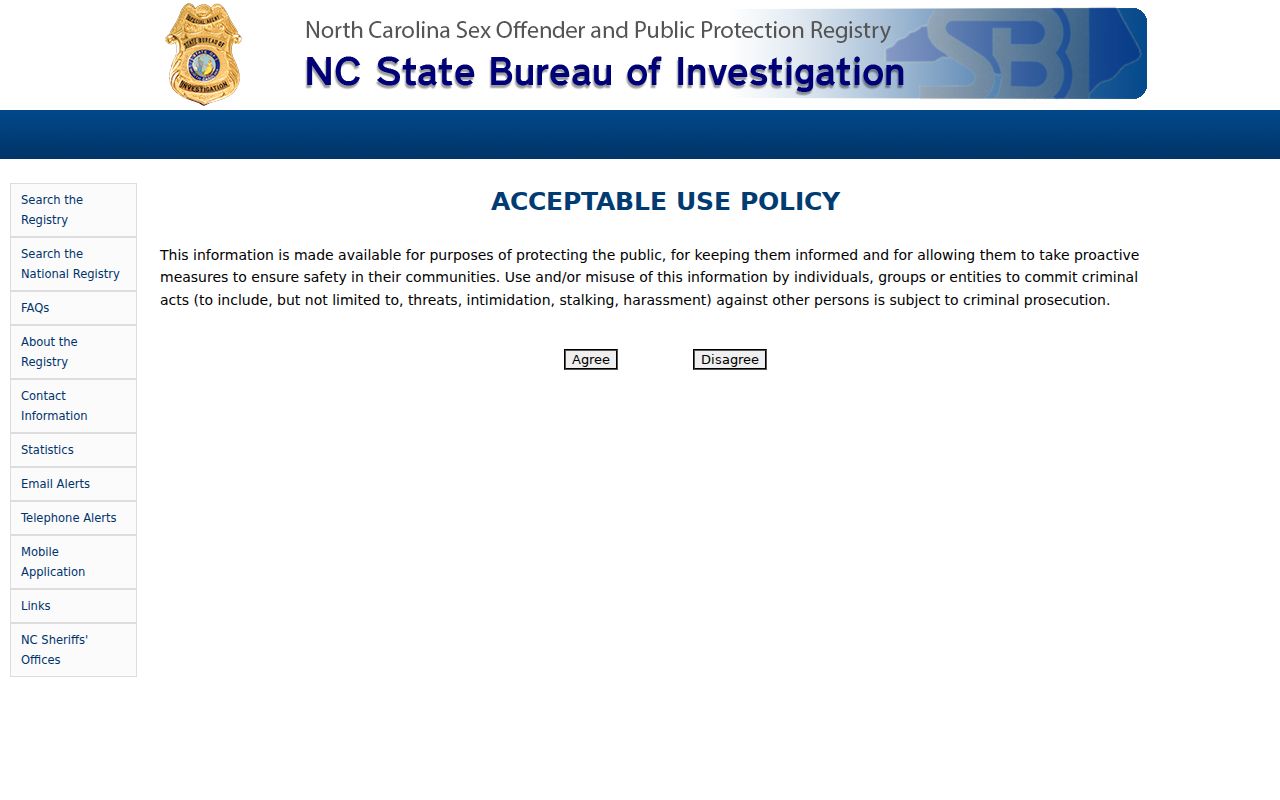
The screen belongs to a public-protection registry, not a general criminal history database. Registry data must never be used to threaten, intimidate, harass, trespass, or commit a crime. Police incident facts, an arrest entry, a court disposition, and a correction record document separate stages and should be matched by case number, date, and identity details.
Archives Extend Durham Records Offline
Online systems favor recent, structured records. Older Durham material may survive in a historical index, paper file, microfilm reel, or archival collection instead. The Register keeps historical indexes at its office. The Durham County Library North Carolina Collection holds local directories, newspapers, yearbooks, and nearly 400 archival collections. The State Archives holds state agency and county-government records, with catalog and research-room help for material that has not been digitized.
The State Archives of North Carolina collections gateway is the official starting point for the assigned archival catalog:
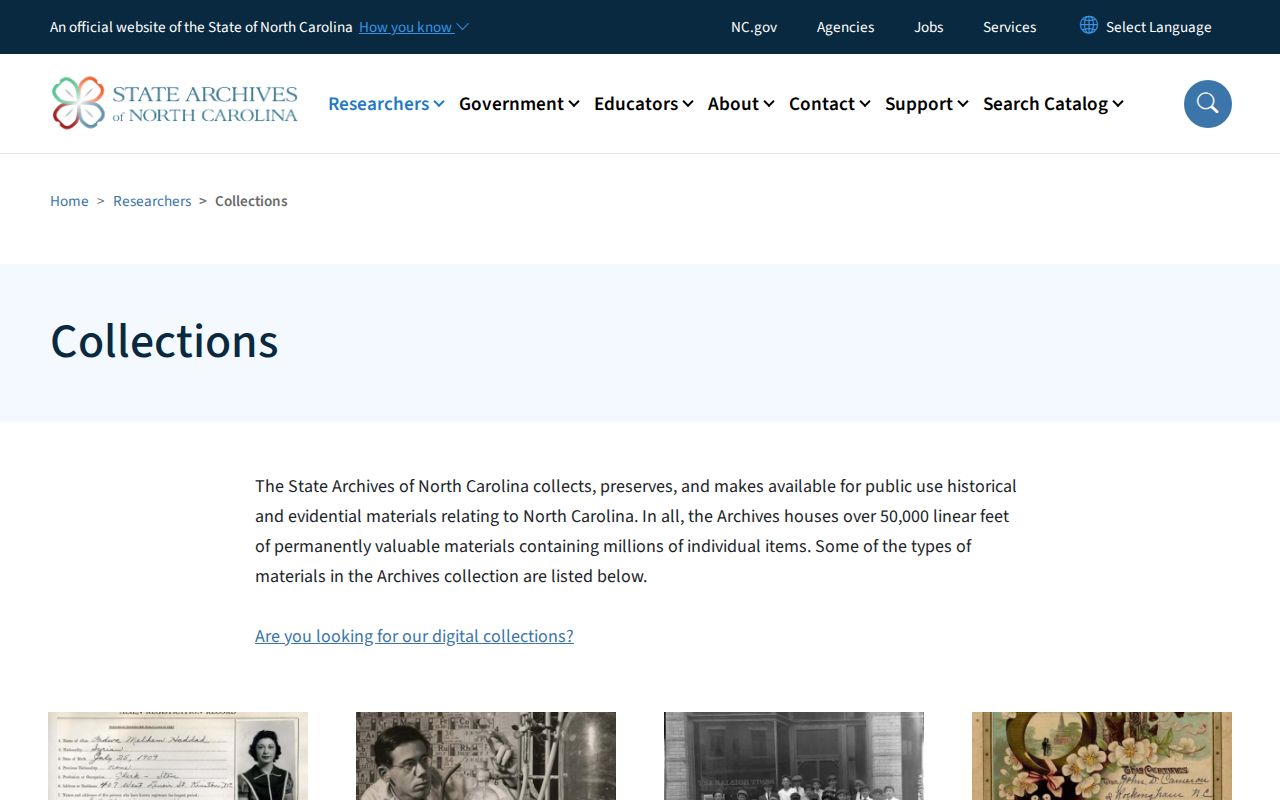
The catalog gateway helps identify a series and its access conditions before a research-room request. It should not be read as proof that every listed file has a web image. For a missing event, trace the responsible office and time period first, then ask the archive or library for the exact record group, index, or microfilm run.
There is no verified Durham courthouse-fire gap in the official research. Avoid assuming that silence online means a destroyed record. The sound fallback chain is the office counter, a precise written request, the library’s local collection, and then the State Archives catalog.
Durham Records Keep Submitted Errors
The Register indexes an instrument as presented and lacks authority to infer or silently change a misspelled party name. When the office learns of an indexing problem, an Administrative Notice may be associated with the original entry, preserving an audit trail. That local rule makes spelling variants more than a generic search tip.
Try the surname alone, alternate first-name forms, initials, former names, and punctuation variants for a company. If an address search fails in the tax system, omit the street type and direction. A parcel’s deed book/page is often stronger than another exact-name query because it points to a known recorded entry.
A no-result screen proves only that the chosen inputs returned no match in that interface. It does not prove that the instrument never existed. Historical indexes, the counter, and a linked prior deed remain the next steps.
Durham Records Use Separate Portals
City and county share the Durham name, but their administrative request portals are not interchangeable. The county request page directs users to search released requests and high-interest documents before filing. It asks for contact details and a precise description. Email provides confirmation and status notices. A person without email can check the portal or contact Public Information at 919-560-0008.
The city directs requests through its own online system and does not accept them by telephone. A city submission can state a known title and date, the record description, contact and mailing details when needed, and a preference for inspection, photocopy, or electronic delivery. Most city responses are free, though actual duplication, storage-media, or extensive search charges may follow advance notice.
The City has an initial response goal of 14 days. Chapter 132 still controls the legal timing and says “as promptly as possible,” without a fixed statewide day count. Sheriff files go to the Sheriff, deeds to the Register, court files to the clerk, and state records to the state agency. Sending every request to the county portal only adds routing delay.
Request Durham Public Records
A useful request identifies an existing record rather than asking an agency to create a report or answer a broad question. Start with the legal keeper, then state the record series, subject or party, date range, and any case, parcel, book/page, or instrument number. Ask for inspection or native electronic delivery when an authenticated copy is unnecessary.
- Identify the office that created or keeps the file. Do not route city, Sheriff, court, Register, state, or federal material through the county’s general portal.
- Search the official index and prior-request library. Record stable keys such as a case number, REID, PIN, deed citation, or request number.
- Submit a narrow description with date bounds, known names, record type, and preferred format. Keep Social Security numbers, full birth dates, account data, and other secrets out of public request text.
- Ask for a fee estimate before extensive work begins. Choose a certified copy only when authentication is needed.
- If material is withheld, ask for the statute behind each category and release of the nonconfidential portions. Narrow scope before considering the Chapter 132 remedy.
Lawful use and fees. Open access supports civic review, family history, estate research, and verification. It does not permit stalking, threats, harassment, or misuse of protected data. Ordinary copies follow actual-cost rules unless another fee applies, while certification and extensive service can cost more.
Protected identifiers in an online deed or court image have a separate remedy under G.S. 132-1.10. The person whose identifier appears may send a signed request that names the data, identifies the document, and locates the item on the page. The register or clerk removes it from the public image without charging a fee, but the recorded instrument itself remains intact. Address Confidentiality Program records, sealed matters, and other protected categories follow their own statutes.